
This is something everyone has a reference for, but few founders and business owners get right. You are not for everyone, and everyone is not for you.
It’s easy to get attached to our ideal version of self. The greatest offering. The best value. The one service nobody does quite like you do. I hate to burst your bubble, but there are lots of people who are also great at exactly what you do.
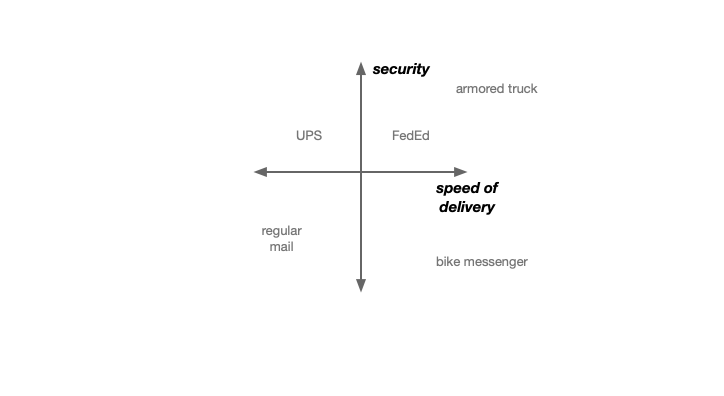
Marketing pioneer Seth Godin made this point in his canonical book This is Marketing. Start by drawing yourself a quadrant.
Pick two axes. It doesn’t matter which two at first. You know your craft. You know your industry. It could be price, convenience, availability, security, performance, environmental impact, safety, privacy, or professionalism.
In Godin’s example, he describes a service that gets something from across town and delivers it to customers. On the X axis, we’ll put security. On the Y-axis, we’ll put the speed of delivery.
Sending a diamond ring? You might want an armored truck. Fast and secure.
Got a document you can’t email? You might need it there today and not care much about security. A bike messenger works.
If speed isn’t important, use UPS or regular mail. If speed and security both matter, pick FedEx or that armored truck.
Godin puts it this way: “The magic of XY positioning of extremes is that it clarifies that each option might be appropriate, depending on what you seek.”
Now do this for your own business. Pick two axes that make the exercise interesting. Put yourself in the quadrant where you belong. Then plot your competitors too.
Once you see it laid out as a picture, positioning starts to make sense. The naive owner picks the axis he thinks is most popular, the thing most people say they care about. That’s a trap. A crowded quadrant is hard to grow in. Everyone in it fights for the same customer on the same terms.
Find two axes that others overlooked. Then build a true story that lands you in the corner where you are the clear and obvious choice.
This lesson has many names. In biz-speak you hear “we’re the Buick, not the Cadillac,” or “we’re the boutique, not the big agency.” The core principle stays the same. Stop fighting for the crowded corner. Claim the corner that already belongs to you.
Getting the exercise right
A few things matter when you actually run this.
Be honest about your competitors. Plot them where customers put them, not where you wish they sat. The map only works if it’s real.
Pick axes your customers care about. You can own a corner that nobody wants and win nothing. Aim for a corner that matters to buyers and sits empty.
Make the story true. Godin is firm on this. Positioning is a promise. If you claim “fastest” and you aren’t, the map falls apart the first time someone tests it. Pick the corner you can actually defend.
The closer
Do the exercise this week. Two axes. Four corners. You and your competitors on the grid. When you find your open corner, the rest of your marketing gets easier. Your message, your pricing, your pitch all start pointing the same direction.
You don’t have to win the whole map. You have to own one corner and tell a true story about why you’re standing in it.
You are not for everyone. Good. Go be the perfect fit for someone.